Since the conflict involving Iran began earlier this year, shipping through the Strait of Hormuz has been badly disrupted, oil prices have swung sharply and UK diesel has hit record prices at the pump. Understandably, a lot of you have been asking us about storing fuel at home or on site: what is sensible, what is legal and what kit you need.
This guide covers the UK rules in plain English. One request first: please don't stockpile. Panic buying is what empties forecourts, and fuel doesn't keep forever. A sensible reserve for your mower, generator or machinery is one thing; a garage full of cans is a fire risk and, above 30 litres of petrol, a legal issue.
Storing petrol at home: the 30 litre rule
Petrol at homes and other non-workplace premises is covered by the Petroleum (Consolidation) Regulations 2014. In short:
- Up to 30 litres: no need to tell anyone, as long as it is in suitable containers.
- 30 to 275 litres: you must notify your local Petroleum Enforcement Authority (PEA) in writing. That is usually your fire and rescue service or trading standards.
- Over 275 litres: you need a petroleum storage licence from the PEA.
The 30 litres includes any cans kept in a car parked in your garage or on the drive, but not the car's own fuel tank.
Which containers can you use for petrol?
- Plastic containers up to 10 litres that are designed and marked for petrol.
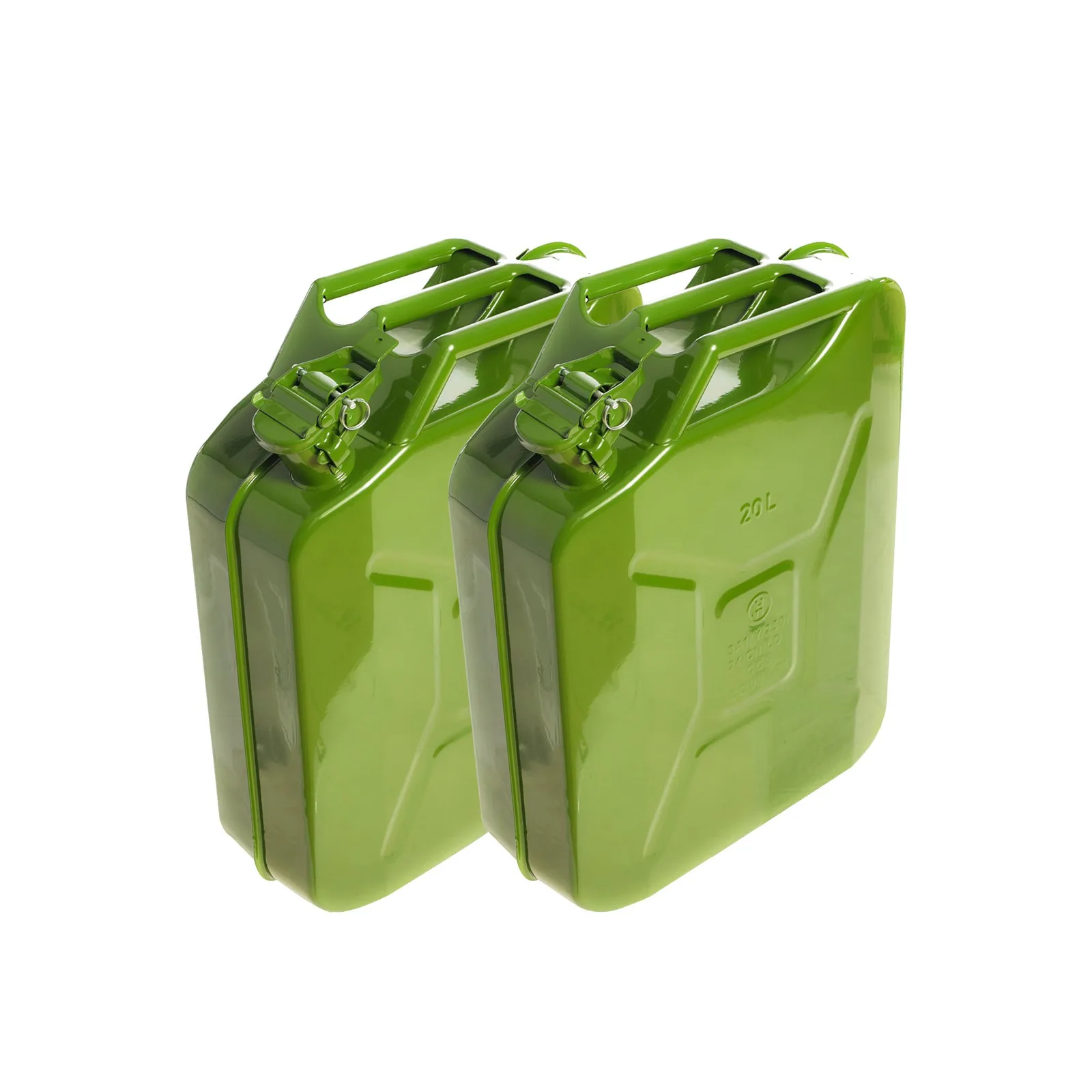
- Metal containers up to 20 litres.
- Or one demountable fuel tank of up to 30 litres.
Keep cans tightly closed, labelled "Petrol" and "Highly Flammable", and store them in a garage or shed away from the house, out of direct sun and well away from anything that could ignite the vapour (boilers, freezers, tools that spark). Never keep petrol inside your home.
For petrol: 10 litre plastic jerry can · 5 litre plastic jerry can · 20 litre metal jerry cans (pair)
Storing diesel
Diesel is far less volatile than petrol, so the 30 litre limit doesn't apply. Instead, in England the Control of Pollution (Oil Storage) Regulations 2001 are about stopping leaks reaching drains and watercourses:
- 200 litres or less: outside the regulations.
- Over 200 litres at a business, farm or site: the tank needs secondary containment (a bund) that holds at least 110% of the tank's capacity.
- At a single private house: the regulations only apply above 3,500 litres, although Building Regulations still cover new or replacement fixed tanks.
Scotland, Wales and Northern Ireland have their own versions with different thresholds, so check with your environmental regulator if you are planning a larger tank.
For diesel: 200L portable diesel tank with 12V pump · 230L tank with pump and filter · 400L portable diesel tank · 12V transfer pump
Our portable diesel tanks are for diesel only and must not be used for petrol.
How long does fuel keep?
- Petrol starts to go stale after a few months, and E10 tends to go off sooner because the ethanol absorbs moisture. Stale petrol is one of the most common reasons a mower or generator won't start in spring.
- Diesel keeps longer, up to around a year if the container is clean, sealed, cool and kept free of water.
Rotate what you store: use the oldest can first and top up with fresh fuel, rather than buying a large batch that sits for a year.
Our advice
- Work out what you actually use in a month, and store that, not more.
- Use the right container for the right fuel, and keep petrol to 30 litres at home.
- Fill cans on the ground at the forecourt, never in the car boot.
- Keep fuel cool, sealed, labelled and away from the house.
- If you store diesel in bulk for a business, make sure the tank is bunded.
Not sure which tank or can suits you? Call our team and we'll help you choose.
This is a summary of the main UK rules, not legal advice. For anything above the limits here, check with your local Petroleum Enforcement Authority or environmental regulator.